
Frazil Ice and our Power System: The trouble with frazil
February 26, 2026
Newfoundland and Labrador Hydro operates 13 hydroelectric generating stations – from Churchill Falls and Muskrat Falls in Labrador to Bay d’Espoir and the Exploits System on the Island – providing electricity to the people of province and beyond.
On the Island, customers are served by our interconnected electricity system which connects all of our Island-based generation assets as well as Muskrat Falls via the Labrador Island Link, allowing electricity generated in Bishop’s Falls to power homes in St. Anthony or businesses in Mount Pearl and everything in between.
The largest of the Island generating stations is the Bay d’Espoir Hydroelectric Generating Station. Opened in 1967, it’s the backbone of our Island system providing more than 600MW of power. Its location, built on a reservoir, has provided safety from the hazards most associated with plants built on rivers.
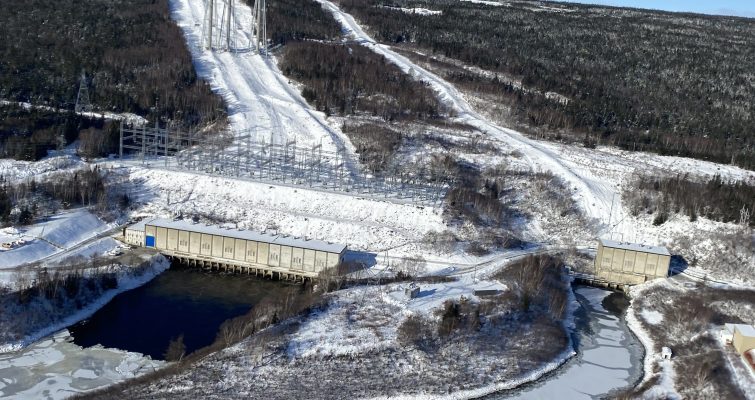
One of the largest winter-time threats to plants built on rivers is the impact of frazil ice. Normally found in fast-moving waters, frazil ice occurs when there is no ice cover and winds churn the cold water creating a thick slush. This slush coats the pipes that pull the water into our generating plants, blocking the flow of water.
Hydro is used to dealing with frazil ice, we have contingencies in place at the plants on flowing rivers. But at Bay d’Espoir – built on a mostly still reservoir – frazil ice is so rare that it’s only happened once in the past 59 years, and that instance was relatively minor.
But in January 2026, the perfect combination of elements saw the Bay d’Espoir Hydroelectric Generating Station come to a halt for the first time in its history thanks to frazil ice.
Rapidly changing conditions at the Station
In the days leading up to January 21, the reservoir at Bay d’Espoir had little ice cover thanks to a relatively mild winter. As the temperature quickly dropped and westerly winds picked up, that open water began to churn and the first instances of frazil ice appeared. The team began reducing output on some of the units, which, under normal circumstances, would help create ice cover. But the extreme cold, combined with the wind direction saw frazil form quickly. By the end of the day, all seven generating units at the Station were offline.
The unexpected loss of more than 600MW of electricity put our system in a precarious situation, and led us to first issuing a customer Power Watch and then a Power Warning for the first time in a decade. Across the company, teams came together to mitigate the impact on our system – for the next several days our Newfoundland and Labrador System Operator (NLSO), Resource Production and Planning (RPP), and Energy Marketing teams watched the system and worked to secure reserve power while our Operations teams ensured all of our generation assets were fully staffed and ready to go if needed.
Removing ice 30 feet below the water
Meanwhile in Bay d’Espoir, the work of removing up to three feet of frazil ice buildup began. This work is challenging in any circumstance, but the gates that were impacted are 20 feet high, and located 30 feet below the surface of the water.

To get a sense of what would be required, a remotely operated vehicle (ROV) was deployed to bring images to our team – but the ice was so thick it was unable to reach all of the gates. A dive team was brought in, and they quickly began the work of removing the ice using hand tools. The work was difficult and initial progress was slow. As they worked below the surface, our team brought in air compressors to help loosen the ice overnight. Because of the configuration of our intake gates and generating units, all three gates had to be clear of frazil before any unit could be started.
With the compressors working overnight on all three intake gates, the dive team was able to make incredible progress on the morning of January 24 and reported the ice was coming off in chunks the size of mattresses. By that evening, intake gates 1-3 were cleared of ice, the headpond had ice cover up to the gates and our crews were able to start the process of starting up the units.
Despite the precarious situation, our teams were able to manage the system and avoid any customer outages.
This event was the first time in its history that the Bay d’Espoir Hydroelectric Generating Station was fully offline. The incredible work done by the teams in Bay d’Espoir, the contracted dive teams and numerous supporting teams across Hydro, meant that this potentially devastating situation was handled without customer impact, and most importantly safely.
Check out the other stories in this series:
Frazil Ice and the Power System: Keeping customers informed when it matters most
Frazil Ice and the Power System: How our teams respond in the NLSO
Frazil Ice and the Power System: The behind-the-scenes role of Energy Marketing and RPP