Labrador West Transmission Expansion Study

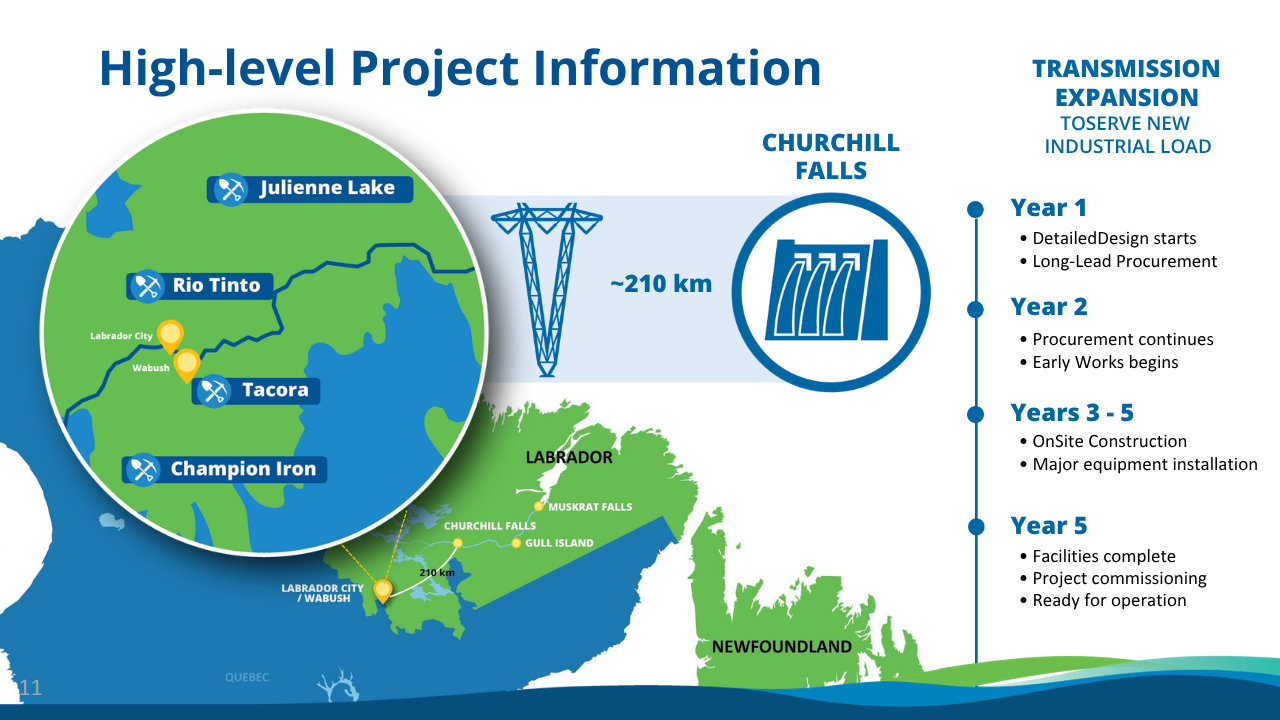
Labrador West’s economy is anchored in the mineral sector. In fact, the Labrador Trough contains several major open pit deposits which together have produced more than 2 billion tonnes of iron ore. Existing reserves and resources suggest the region could see production for many decades to come, potentially serving as a stable, responsible supplier of critical minerals that positions the province (and Canada) to lead in low-emission green steel supply chains.
However, attracting new investment to the province requires expanded energy infrastructure. Expanding transmission infrastructure is not only fundamental to unlocking the full industrial and economic development potential for the region but will also give customers access to significantly more power.
This opportunity is met with several generation and transmission challenges:
- Churchill Falls Generating Station has minimal surplus capacity to serve new loads in Labrador.
- Existing 230kV lines from Churchill Falls to Labrador West are at operational limits, restricting additional power delivery.
- Under existing regulatory framework, Labrador customers must provide up-front funding for the capital costs associated with transmission expansion to enable their project.
Overcoming the cycle in which projects depend on transmission and transmission depends on projects will require innovative engineering, modern financing approaches, and coordinated government support.
In 2024, funding was announced through the federal Smart Renewables and Electrification Pathways Program for NL Hydro to undertake a feasibility study to help expand electricity transmission infrastructure to support mining in the Labrador West region of Newfoundland and Labrador. The funding, in addition to contributions by industry, was provided to NL Hydro to advance requests by four large mining customers operating in Labrador West for additional power to support existing operations and future critical mineral projects.
The first phase of this study identified a single 735 kV transmission line as the preferred solution which will allow for a maximum power transfer limit of approximately 1500 MW.
The next steps in advancing the study are:
- Geotechnical Field Investigations in Summer/Fall 2026.
- Front-End Engineering Design (FEED) for a single 735 kV line and stage-one Flora Lake Terminal Station targeted for completion in December 2026.
- Engagement and consultation.
STATUS Currently undertaking Front End Engineering Design (FEED) and pursuing environmental permits for geotechnical field investigations Summer/Fall 2026.